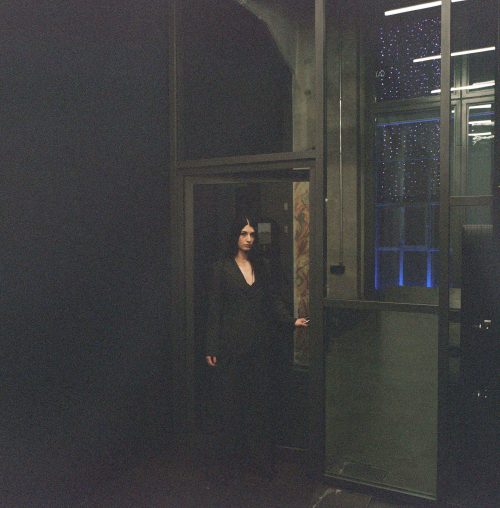
Jakub Czyż, Konrad Gubała, Martyna Kielesińska, Weronika Kocewiak, Anna Siekierska
parachute
Project Info
- 💙 Przeciąg Gallery
- 💚 Weronika Kocewiak
- 🖤 Jakub Czyż, Konrad Gubała, Martyna Kielesińska, Weronika Kocewiak, Anna Siekierska
- 💜 Weronika Kocewiak
- 💛 Zuzanna Wudarska
Share on

Martyna Kielesińska, „Little Mobile”, 2026, 30 x 30 x 70 cm, Konrad Gubała, „Saints Losers”, 2026, 21 x 30 cm, Konrad Gubała, „Little table set yourself... and cover your ears”, 2026, 60 x 80 x 75 cm
Advertisement


Konrad Gubała, „Little table set yourself... and cover your ears”, 2026, painting polished with polishing paste on sheet metal mounted on a stretcher frame, wood, varnish, 60 x 80 x 75 cm

Martyna Kielesińska, Little Mobile, 2026, metal, glass, 30 x 30 x 70 cm, Konrad Gubała, „Saints Losers”, 2026, engraving and varnish on stainless steel, 21 x 30 cm

Konrad Gubała, „Saints Losers”, 2026, engraving and varnish on stainless steel, 21 x 30 cm

Anna Siekierska, „In sheep clothing”, 2025, wood, photography 26 x 30 cm, pencil drawing on paper, print, glass, 80 x 60 x 40 cm

Anna Siekierska, „In sheep clothing”, 2025, wood, photography 26 x 30 cm, pencil drawing on paper, print, glass, 80 x 60 x 40 cm

Weronika Kocewiak, „Eyebrow adjustment and adjusting the Tensions (while I clean the mirror)”, 2025, Martyna Kielesińska, „Circus Mobile”, 2025, Jakub Czyż, „Insinuations,”, 2026

Martyna Kielesińska, „Circus Mobile”, 2025, metal, glass, 100 x 100 x 100 cm

Martyna Kielesińska, „Circus Mobile”, 2025, metal, glass, 100 x 100 x 100 cm

Jakub Czyż, „Insinuations,”, 2026, oil on canvas, 65 x 81 cm

Jakub Czyż, „Insinuations,”, 2026, oil on canvas, 65 x 81 cm, Jakub Czyż, „The last leaf”, 2026, oil on canvas, 140 x 90 cm

Weronika Kocewiak, „THE WRINGER”, 2021 – 2026, drawing installation, galvanized steel, ceramics, 320 x 190 x 54 cm, Martyna Kielesińska, „Legs”, 2026, ceramics, 26 x 33 cm

Weronika Kocewiak, „THE WRINGER”, 2021 – 2026, drawing installation, galvanized steel, ceramics, 320 x 190 x 54 cm, Konrad Gubała, „Clock machine”, 2026, engraving and varnish on stainless steel, 21 x 30 cm

Jakub Czyż, „Mask”, 2025, oil on canvas, 92 x 73 cm

Weronika Kocewiak, „Stages of tasting”, 2026, oil on canvas, 116,5 x 63 cm

Konrad Gubała, „Until Death”, 2026, engraving and varnish on stainless steel, 21 x 30 cm, 2026, Martyna Kielesińska, „Large Mobile”, 2026, metal, glass, 60 x 60 x 120 cm

Martyna Kielesińska, „Large Mobile”, 2026, metal, glass, 60 x 60 x 120 cm

Anna Siekierska, „Transhumance”, 2025, wood, sheep wool, 80 x 60 x 40 cm, Konrad Gubała, „Until Death”, 2026, engraving and varnish on stainless steel, 21 x 30 cm, 2026

Anna Siekierska, „Transhumance”, 2025, wood, sheep wool, 80 x 60 x 40 cm

Jakub Czyż, „Resistance”, 2026, oil on canvas, 160 x 150 cm
As a counterpoint to the prevailing belief in the dominance of a world driven by the pursuit of
progress – a world focused on achieving ever-higher levels and promotions – artists, immersed in a dark fantasy, ensure we do not forget what troubles, gnaws at and weakens us; in short, what makes us human.
"parachute" is an exhibition about the means of survival. It is a collection of peculiar stories about how the body and mind react to change, to external and internal stimuli, and to the unexpected. A jump can, in reality, have two origins: it may be voluntary, or it may sometimes be a matter of necessity. The moment of the jump is a time of bodily reorganisation, as if the mind has not yet realised that it is falling, or conversely, it is a purely intellectual decision to change the body’s position and the trajectory of its movement. Falling is a somatic surprise, a suspension between the past and the present. A liminal space in which nothing that is entirely real exists. At the same time, it is a moment of the body’s maximum efficiency, as well as its complete inertia. And what if this mixture contains a method for survival?
The artists, in their practice, tread a fine line between a lack of control and a regime of repetition. They represent a group of distinct individuals who analyse the reality around them, and the sum of these impressions – physical, emotional and sociological – forms the subject of their work. However, there is another, perhaps even more important common denominator: each of them dreams of adapting the world to their own rules of the game. They use a variety of materials, ranging from wood, metal and glass to more ephemeral elements such as sweat or play of light and shadow, right through to traditional painting on canvas. Their artistic methodologies are bound by their work with embodied matter; thus, the body finds its way into each of their individual narratives. A record of repeated approaches to the deformation of the body, the rescaling of form or its dismemberment, the stripping away of its senses, or the reaching back to the most primal, animalistic bodily matter.
They are no strangers to the posthumanist narrative, both in terms of the dream of reuniting
with one’s inner primal self and the utopian vision of sublimation through the natural world that surrounds us. Nor are they oblivious to the capitalist narrative of ‘de-animalising’ humanity in the name of standardisation, resulting in the creation of a posthuman – a cyborg. A thinking being, yet limited in sensation or hypersensitive, yet physically capable of using one’s own body as a tool in an anomalous manner.
On the other hand, their work points to a discipline-based life – one founded on the illusion of freedom. These peculiar visions are delusions of free will, in which routine blends with the compulsive repetition of daily tasks, resulting in works based on multiplication: of brushstrokes, incisions or structural elements. The attempt to bring together such diverse works in a single space may constitute a clear message: a call for attention to our primal needs, both physiological and psychological. As well as the hunger for the transformative, cyborg-like nature of Homo sapiens.
Ultimately, the title's parachute jump is not a foreshadowing of collapse; on the contrary, it
encourages a shift away from the dystopian narrative of the end (of humanity).
Weronika Kocewiak