Ada Van Hoorebeke, Alwin Lay, Amedeo Polazzo, Ana Navas, Erika Hock, Ida Kammerloch, Karla Zipfel, Paula Erstmann, Sarah & Charles, Samuel Treindl, SpätiSpäti, Yoel Pytowksi, fusion lab
_ _ _ STADT
Project Info
- 💙 Kunstverein Siegen
- 💚 Jennifer Cierlitza
- 🖤 Ada Van Hoorebeke, Alwin Lay, Amedeo Polazzo, Ana Navas, Erika Hock, Ida Kammerloch, Karla Zipfel, Paula Erstmann, Sarah & Charles, Samuel Treindl, SpätiSpäti, Yoel Pytowksi, fusion lab
- 💜 Jennifer Cierlitza
- 💛 Alwin Lay
Share on

Advertisement


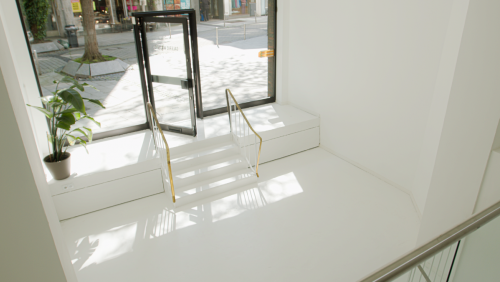
With _ _ _STADT, Kunstverein Siegen opens a place never intended as an art venue:
the vacant Karstadt department store. Where shoppers and goods once moved
along escalators, shop windows seduced passers-by, and consumption set the
rhythm, a temporary space for artistic and architectural engagement now emerges.
A former department store—like in many other cities a symbol of inner-urban
structural change—becomes a site of experimentation. Located on “Germany’s
steepest shopping street,” at the threshold between lower and upper town,
questions of future, identity, and urban public space converge. What does vacancy
mean in a city in transition? Which stories are stored within these spaces—and
which new ones can begin here?
In collaboration with Kunstverein Siegen and the Neue Architekturschule (N_AS)
of the University of Siegen (Prof. Tobias Hönig, Prof. Tobias Becker), a section of
the building transforms into an open laboratory. Artistic works, student designs,
and participatory formats interweave.
An accompanying program of salons, lectures, film screenings, guided tours, and
performative contributions connects the exhibition to current debates on urban
development and turns vacancy itself into a subject of public discourse. Vacancy is
not understood as a deficit, but as a space of possibility—a stage for alternative
models of publicness.
The exhibition brings together artistic and architectural positions that explore how
spaces gain new meanings through appropriation, reuse, and design. It addresses
urban transformation—disappearance and persistence, buildings as repositories of
past promises and as projection surfaces for future development.
The participating artists examine material cycles and production processes, reflect
on notions of dwelling and private space, and engage with transitions between
interior and exterior as well as forms of presentation and staging. At its core lies
the question of how artistic and architectural modes of thinking respond to urban
transformation—and how they themselves can act transformatively, making
change not only visible but sensorially tangible.
___STADT extends beyond the former department store. The surrounding urban
space and Haus Seel, the Kunstverein’s established exhibition venue, also become
part of the project. A network of places, perspectives, and actors unfolds.
Jennifer Cierlitza