Sofiia Yesakova, Anzhelika Palyvoda, Céline Struger
Echoes that refuse to fade
Project Info
- 💙 FAVU gallery / Brno
- 💚 Massimiliano Maglione
- 🖤 Sofiia Yesakova, Anzhelika Palyvoda, Céline Struger
- 💜 Massimiliano Maglione
- 💛 Viola Hertelova, Polina Davydenko
Share on

Sofiia Yesakova, Céline Struger, Anzhelika Palyvoda, FC Polina Davydenko
Advertisement


Sofiia Yesakova, Céline Struger, Anzhelika Palyvoda

Anzhelika Palyvoda, FC Polina Davydenko

Sofiia Yesakova, Céline Struger, FC Polina Davydenko

Sofiia Yesakova, Céline Struger, FC Viola Hertelova

Céline Struger, Anzhelika Palyvoda, FC Polina Davydenko

Céline Struger, FC Polina Davydenko

Céline Struger, FC Viola Hertelova

Sofiia Yesakova, FC Polina Davydenko

Anzhelika Palyvoda, FC Polina Davydenko

Sofiia Yesakova, Anzhelika Palyvoda, FC Polina Davydenko

Céline Struger, FC Polina Davydenko

Sofiia Yesakova, Anzhelika Palyvoda, FC Polina Davydenko

Anzhelika Palyvoda, FC Polina Davydenko

Céline Struger, FC Polina Davydenko

Sofiia Yesakova, FC Polina Davydenko

Sofiia Yesakova, Céline Struger, Anzhelika Palyvoda, FC Viola Hertelova

Sofiia Yesakova, FC Viola Hertelova
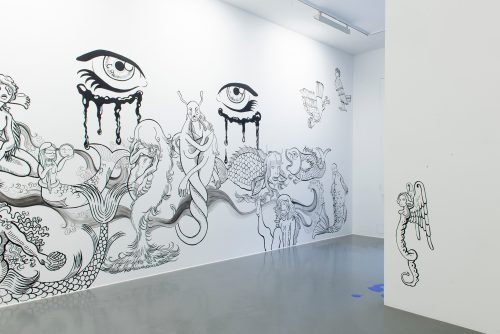
The exhibition brings together the practices of Sofiia Yesakova, Céline Struger, and Anzhelika Palyvoda within a single conceptual framework in which generational trauma, dark nostalgia,
structures of power, and residual points of view intertwine as articulations of the same process, traces that share a common origin and continue to reactivate over time in different ways.
Not everything that the past leaves behind takes the recognizable form of memory. There are inheritances that escape a linear reconstruction, that cannot be fixed in clear images or complete narratives, and that instead continue to act in the present as residues, entering language, architecture, and the very ways through which the gaze takes position in the world.
These traces do not function as contents to be recovered, but as latent forces that continuously alter the present, producing perceptual shifts and unstable configurations in which what has been
does not stop redefining what is.1 More than distinct areas, these elements appear as articulations of the same process, traces that share a common origin and continue to reactivate over time inbdifferent ways.2 In this intertwining, difference does not oppose repetition but passes through it,
generating variations that do not interrupt the process but relaunch it, making every return a transformation rather than a simple repetition.
In this perspective, the past does not present itself as an object to be reconstructed, but as a force that continues to act. Memory is therefore defined as an unstable process, made of
accumulations, shifts, and returns, in which what has been lived or removed settles without ever fully disappearing.3 It remains in surfaces, in materials, in the images that pass through daily life, in
the forms we inhabit and that help structure our experience. Within this movement, trauma is distributed in a diffuse, almost imperceptible way, integrating itself into the present until it
becomes confused with it.4 In this sense, trauma does not simply survive as content, but is inscribed in the very devices of perception, producing a progressive normalization that weakens
its recognizability without removing its force.
Power also takes shape according to this dynamic. Before becoming visible in its institutional articulations, it takes form within a shared imaginary, rooting itself in myths, beliefs, rituals, and narratives that symbolically organize a community.5 These structures do not end with their original context, but tend to transform and re–emerge in new configurations, maintaining an
underground continuity that crosses different eras. Power thus appears less as an external imposition and more as an internalized form of organizing reality, capable of directing behaviors,
desires, and forms of adherence without the need for explicit control.
Massimiliano Maglione