Irene Molina, Naomi Maury, Mit Borrás, Aquiles Jarrín, Simon Speiser, Ju Young Kim
INTERFAZ
Project Info
- 💙 Ventana Project
- 💚 Ventana Project - Roberto Rivadeneira
- 🖤 Irene Molina, Naomi Maury, Mit Borrás, Aquiles Jarrín, Simon Speiser, Ju Young Kim
- 💜 Ventana Project
- 💛 Nico Tappero @nicotappero
Share on

From Left to right: Aquiles Jarrin, Mit Borrás, Irene Molina, Naomi Maury, Ju Young Kim
Advertisement


From Left to right: Naomi Mauri, Irene Molina, Ju Young Kim

Mit Borras

Irene Molina

Naomi Maury

Mit Borras


Aquiles Jarrin

Irene Molina

From left to right: Naomi Maury, Irene Molina, Ju Young Kim, Simon Speiser
All technology translates. It does not execute an idea; it subjects it to passage. Between
intention and its emergence as object, image, sound, or space, an intermediate zone opens
where decisions, scales, durations, and systems intervene. That interval—neither purely mental
nor strictly material—is the interface.
To translate implies loss and gain. Thought becomes code; code becomes instruction;
instruction becomes matter. Yet the process is not transparent. Each tool introduces a logic,
each material a resistance, each machine a rhythm. The interface is not merely a point of
contact between human and device; it is a space of negotiation where tolerances, densities, and
velocities are determined. There, the abstract acquires a body and matter assumes one form
among many possible ones.
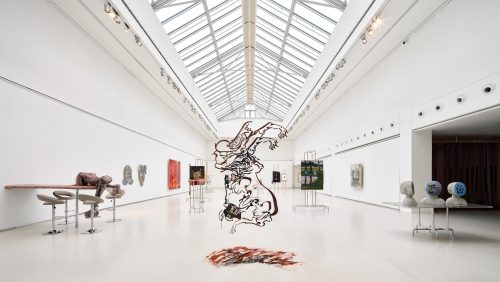
INTERFAZ is organized as a constellation rather than a linear narrative. A first moment,
composed of signs, keys, and inscriptions, proposes a threshold of reading. There is something
of ritual order—perhaps even of the sacred—but also of the technical: a system suggesting that
every image responds to a prior structure. Further on, those signs condense into volume. What
was inscription becomes object; what seemed symbol acquires weight and scale.
The path can also be reversed: from object to code, from volume to trace, from form to system.
This reversibility activates the interface as experience—a place where each element refers to a
process of translation not exhausted by what is visible.
The artists gathered in this exhibition work within that unstable band. They combine code,
drawing, printing, weaving, sound, and assembly without concealing the presence of the
machine or the technical architecture that sustains the work. Technology is not disguised; it is
made evident. And yet the human does not disappear. It remains as tension, as a gesture that
interrupts repetition, as a sensibility that traverses calculation.
Ventana Project