Group Show
Words of a Poem Should Be Like Glass

Advertisement


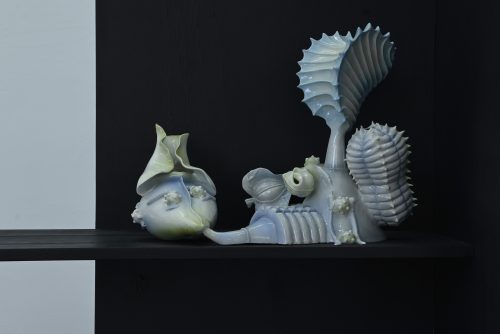
The group exhibition Words of a Poem Should Be Like Glass focuses on glass as a material and as a symbolic phenomenon. It presents artists of different generations who work with its materiality from various perspectives and through different media. Glass is understood here not only as a traditional artistic material with deep roots in the Czech environment, but also as a carrier of specific properties such as transparency, fragility, and reflection, which open up broader considerations of visibility, space, and perception. The exhibition follows on from the annual program of the Hunt Kastner, which presents a selected theme in a broader context through thematically defined group projects.
Surface as an Event
This morning, I saw muskrat tracks on the frozen, snow-covered river. I'm looking for something here, but I don't know exactly what or why. The only evidence so far is that I'm returning—as if something happened here or is about to happen. "Nak, come here!" I shout at the dog. Nak, about 20 meters ahead of me, stops and reluctantly shuffles back.
With every dialogue, language undergoes a load-bearing test: can it carry the expressions we exchange and the meaning we put into them? The substance of words is relationships. A thin, transparent bond between what is said, what it refers to, who is speaking, and to whom. A bond as fragile as pre-war glass; as soon as it cracks, the surface of meaning breaks through. The stream beneath it murmurs. What moves in it could be anything.
The ice may be thick enough, or maybe not. Maybe it would be possible to cross to the other side or set off straight out onto the river itself. I hesitate for a moment. Nak tilts his head suspiciously toward the ice, sniffing it as if it were a strange animal. My cell phone vibrates in my pocket, then goes silent. I don't want to talk to anyone right now, not here. Let's go.
The level of meaning, the plane of language, and the thin ice of understanding between two shores. When does a word still reliably convey what I know, and when does it take on a meaning that I no longer understand? The medium reveals itself in its fragility, not where it is solid, in its unpredictability, not where it is transparent. Trying to pierce the glass of a window, a display case, or a storefront with your gaze is like trying to break language with speech. At that moment, language either shines or falls apart. To feel the medium is to take a risk: either a loss of meaning or a discovery—all or nothing.
Footsteps crunch on the snow-covered shore. Footprints are the only sign of life in the silent landscape. Nothing else has happened, so they stand out. Mine, the dog's, and the muskrats’ are strung together like small events and disappear into the white. No... that analogy doesn't work. Just like the river, the shore, the ice, or the snow-covered bushes, the footprints undoubtedly exist, but events? Just a necessary illusion of time in which I don't want to get stuck here and now. Events can wait. The tip of my hiking boot hits a rock under the snow.
To stride confidently or tread carefully. Understand clearly or stumble over meaning. The surface matters; we won't meet anywhere else. New connections are uncertain, slippery, and tempting. At the interface of fragile language, the promise and danger of contact, openness and the risk of empathy awaken: not as a feeling, but as friction or touch, a more fervent form of resistance. Where certainty disappears, I measure every step, every word, every assumption. The surface tension is suddenly tangible—I am more tangible too. I perceive that I perceive, even if I don't want to. A fragile event sets itself in motion before it happens. Touchable events.
When I lift the stone, it feels as heavy as the practice grenade I used in seventh grade civil defense day, which I failed to win the throwing competition with. As if my muscle memory had awakened, without further thought I swing my arm and throw it as high as I can. The dog barks in surprise and jumps around confusedly. He waits to see what will happen.
The paradox of language: how can we talk about it other than through language itself? The harder I try to see through it, the more I remain on the surface. The harder I try to stay on the surface, the more I see through it. Language awakens in the rules of perception. Sound and light and what emits and reflects it. Silence closes its eyes. Anything can move in silence and darkness.
Nak wants to get going, but he doesn't know where to go, so he dances around my feet. I watch the ascending black point of the stone, see it pause for a moment at its apex and then fall. Either the stone will break through the ice and sink somewhere into the darkness of the river. Or it will bounce off—and the ice will ring out in alarm. Everything happens in a fraction of a second.
Ondřej Buddeus