Dominika Walczak, Mateusz Wójcik
Material Tendencies
Project Info
- 💙 bliss gallery
- 💚 Katarzyna Piskorz
- 🖤 Dominika Walczak, Mateusz Wójcik
- 💜 Katarzyna Piskorz
- 💛 bliss gallery
Share on

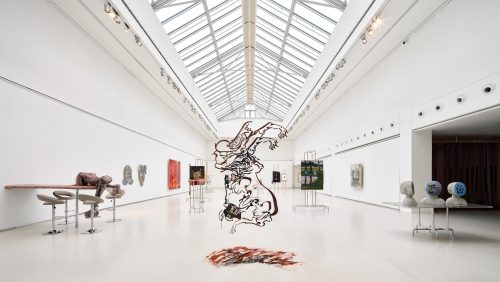
installation view, "Material Tendencies", photo: bliss gallery
Advertisement


Dominika Walczak, "Dream of…", 2025, oil on canvas, 150 x 130 cm, photo: bliss gallery

Dominika Walczak, "Soak Into Resistance", 2025, oil on canvas, 130 x 150 cm, photo: bliss gallery

Mateusz Wójcik, "Comet", 2015, aluminium, glass, 70 x 100 x 120 cm, photo: bliss gallery

Mateusz Wójcik, "Comet", 2015, aluminium, glass, 70 x 100 x 120 cm, detail, photo: bliss gallery

installation view, "Material Tendencies", photo: bliss gallery

Dominika Walczak, "Up in Smoke", 2025, oil on canvas, 150 x 130 cm, photo: bliss gallery

installation view, "Material Tendencies", photo: bliss gallery

Dominika Walczak, "Monument", 2025, acrylic and oil on canvas, 200 x 180 cm, photo: bliss gallery

installation view, "Material Tendencies", photo: bliss gallery

Mateusz Wójcik, "Tower", 2015, aluminium, granite, steel, 100 x 28 x 25 cm, detail, photo: bliss gallery

installation view, "Material Tendencies", photo: bliss gallery

Mateusz Wójcik, "Cutting Edges 3", 2015, cast iron, elastane, 110 x 100 x 80 cm, photo: bliss gallery

Mateusz Wójcik, "Cutting Edges 3", 2015, cast iron, elastane, 110 x 100 x 80 cm, detail, photo: bliss gallery

Mateusz Wójcik, "Cutting Edges 3", 2015, cast iron, elastane, 110 x 100 x 80 cm, detail, photo: bliss gallery

installation view, "Material Tendencies", photo: bliss gallery

Mateusz Wójcik, "Cutting Edges 2", 2016, cast iron, elastane, 70 x 50 x 40 cm, photo: bliss gallery

installation view, "Material Tendencies", photo: bliss gallery

Mateusz Wójcik, "Cutting Edges 1", 2015, cast iron, elastane, detail, 110 x 70 x 40 cm, photo: bliss gallery

Dominika Walczak, "Swarm", 2024, oil on canvas, 180 x 150 cm, photo: bliss gallery
Material reveals its true character in moments when it begins to slip out of control, introducing its own constraints and unpredictability. The exhibition focuses on the effects of these moments where artistic decision-making meets the logic of matter: its tendencies, resistance, flexibility and susceptibility to change. In both Dominika Walczak’s paintings and Mateusz Wójcik’s sculptures, form emerges as a result of negotiation. This tension between intention and what exceeds the assumed order forms a shared axis of the works on view.
Dominika Walczak works through a process in which an initial plan coexists with the need to respond to unforeseen outcomes. A painting develops in stages: the view of each new layer triggers corrections, shifts and changes of direction. Her practice relies on continuous selection; some elements are preserved, others are erased or neutralised. A key notion in her work is the “periphery”, an intermediate zone that belongs neither fully to representation nor to pure abstraction. She is interested in the moment when shapes drawn from reality begin to transition into simplified, abstract configurations. The recognition of forms becomes intertwined with building a network of associations that shift meaning. This is accompanied by an awareness that the record remains incomplete, fragmentary and open to reinterpretation. Walczak’s practice shows that technique and material are not merely tools but partners in the decision-making process. The behaviour of paint, its resistance, opacity or susceptibility to scraping, becomes as important as the gesture of the hand. The painting "Monument" was created on thickly woven canvas whose weave became exposed through successive stages of applying and removing layers. The artist emphasised the natural division of the fabric by using a grid pattern through screen printing. Walczak also consciously draws on visual codes associated with digital media; smooth tonal transitions and gradients introduce a slight sense of unrealness.
In the series "Cutting Edges", Mateusz Wójcik works with iron cast in a way that overturns intuitive expectations of weight and construction. The models are made of styrofoam, and the metal poured over them retains its texture with extraordinary precision; the depressions, pores and lines visible on the surface are traces of the process, an imprint of a temporary structure that no longer exists. This gives the sculptures a double temporality. They are durable, yet based on a material that is inherently fragile and easily destroyed. Some works also incorporate sand used as a forming mass; its granularity, layering and directional structure appear as if they belonged to something light and brittle, although in reality they form a shell of metal. This physical contradiction is deliberate. This contrast of weight and lightness, as well as rigidity and elasticity, further highlights the processual character of the sculptures. Elastane, stretched over sharp edges or wedged between fragments of metal, is an integral element in many works. The material behaves like a membrane responding to the presence of heavier matter; it stretches, bends, and in some places is pinned down as if the iron were breaking into its structure. This contrast of weight and lightness, as well as rigidity and elasticity, further highlights the processual character of the sculptures. They appear as forms caught in the act of shaping or on the verge of collapse, as if the material were trying to hold together a configuration that resists stability. Tarnish and traces of rust on the surfaces function as evidence that the material continues to act; it does not stabilise after casting but changes over time, revealing a tendency toward reaction and subtle transformation. In this sense, the sculptures operate as records of a brief process rather than as fixed figures. The title of the series refers not only to the act of cutting but also to testing critical points, the moments when the material begins to act against the initial assumptions or reaches a state close to breaking.
For both Walczak and Wójcik, form is not a representation but a result of negotiation. The painting and the sculpture arise from overloads, corrections, the pressure of matter and from “errors” that become the actual logic of the work. Their attention is directed toward the moment of transition, when form is still emerging, and its direction is not yet determined. This incompleteness is not a lack but a property of the material, whose reactions become the primary tool of composition.
Katarzyna Piskorz